
Breaking Taboos in Sonbhadra
How our team brought menstrual awareness to one of India's most remote tribal communities — and what they taught us in return.
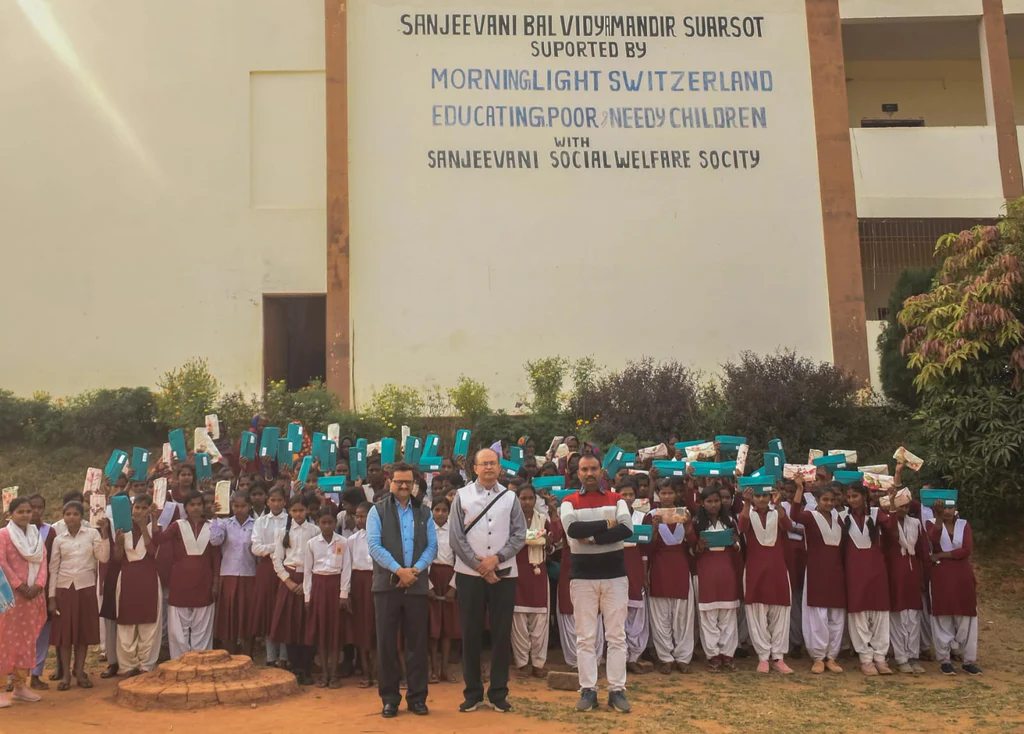
The road to Sonbhadra ends long before the villages do. For the final forty kilometres our jeep crawls along dry riverbeds and footpaths, past Sal forests and hills carved by decades of mining. This is the southeastern edge of Uttar Pradesh — officially "backward", administratively forgotten, and home to some of India's oldest tribal communities.
We arrived with cartons of Saukhyam pads, a portable projector, and an assumption that we were bringing something new. By the end of the week, it was clear we were the ones learning.
A Silence Worth Listening To
In the first village, Kusmaha, nearly sixty women sat with us in a circle under a mahua tree. None of them were using any menstrual hygiene product — disposable or otherwise. Cloth, ash, leaves. The silence around the subject was total, not out of shame, but because no one had ever asked.
“We did not know there were pads that could be washed and used again. We only knew that pads in the city shops cost more than a day's wage.”
— Sunita Devi, 34, Kusmaha village
Sunita's observation cut to the heart of why disposable pads have failed rural India. Even where they are available, the recurring cost is impossible — a household here earns ₹150–200 on a good day of forest-produce collection. A single pack of disposables costs almost that much and lasts four days.
What We Brought, What We Changed
Over three weeks our team visited 14 hamlets across the Duddhi and Myorpur blocks. We distributed starter packs, demonstrated washing and drying, and crucially — trained 23 local women as Saukhyam Sakhis who would continue the conversation after we left.
- 14 villages reached across Sonbhadra district
- 1,200+ women received their first reusable pad
- 23 local women trained as community health ambassadors
- 6 follow-up visits scheduled for quarterly health check-ins

The Drying Problem
One lesson we did not anticipate: in communities where menstruation is taboo, the biggest barrier to reusables is not washing — it is drying. A pad drying on a line is visible proof of menstruation, and in many households that remains forbidden. We now include a small indoor drying net in every rural starter pack, designed to hang discreetly inside a bathroom or corner.
What Comes Next
Three months on, our follow-up survey found 78% of women were still using the pads consistently, and — more importantly — nearly all of them were talking about periods openly with their daughters for the first time. That, more than any metric, is why we drove down that river-bed road.
We will be back in Sonbhadra next quarter. If you'd like to sponsor a starter pack for a woman there, the link is at the end of this article. One pad, two years, one conversation at a time.
Be part of the next story.
Every switch to Saukhyam is a paragraph we haven't written yet.